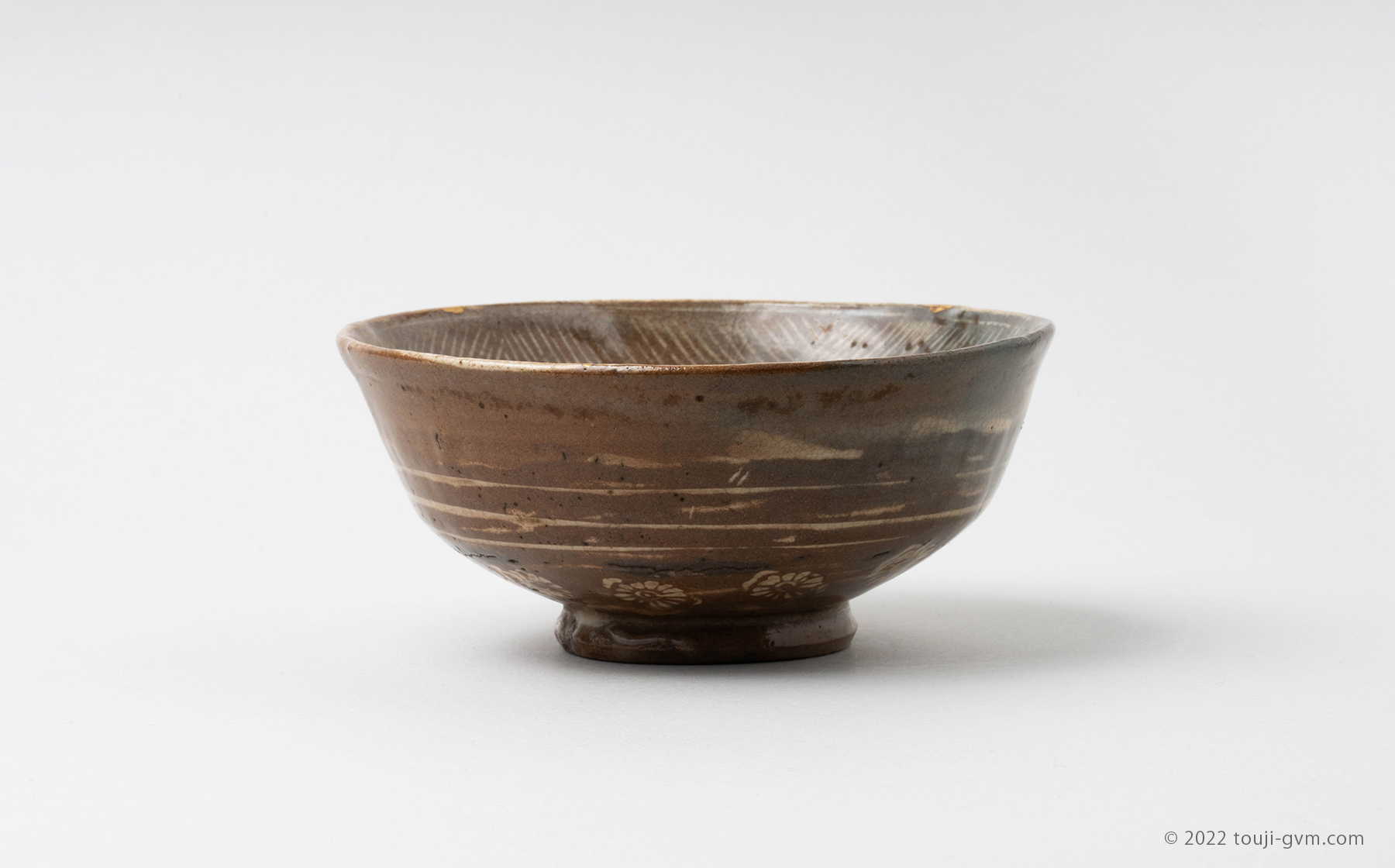
出雲焼は楽山焼と布志名焼の総称として呼ばれ、主に茶陶を焼いておりました。
開窯には松江藩七代藩主松平不昧が関わり、楽山焼は萩焼から、布志名焼は楽山焼から陶工が呼ばれています。
その影響あって特に楽山焼では高麗茶碗を手本として茶碗が作られます。
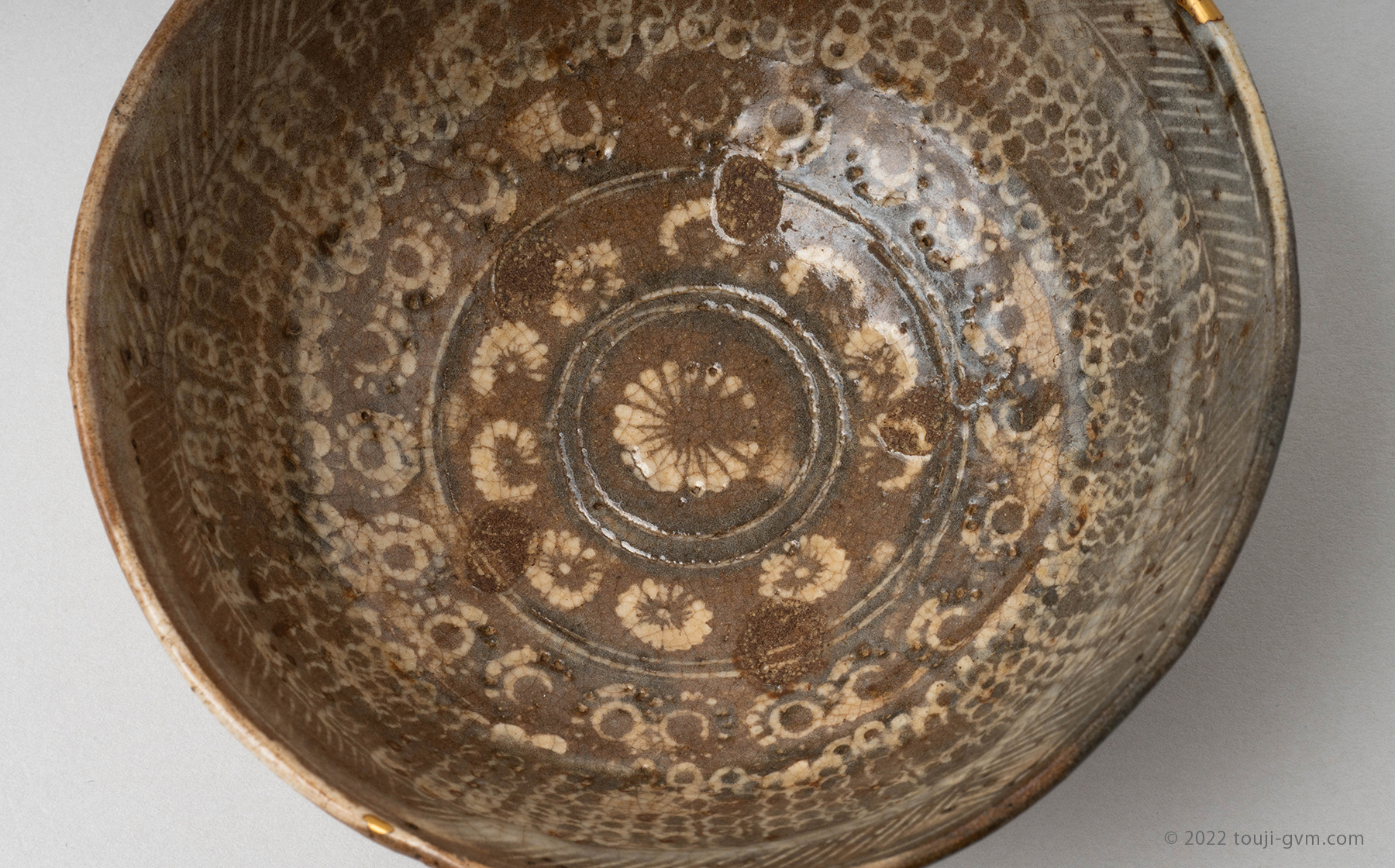
当品も高麗や李朝の三島のように象嵌の技法を用いて模様が施されます。
見込み中央には大きな菊花文、その周りに多数の菊花文を飾り、その外には連珠文と草花文が描かれます。
高台は高麗茶碗のように竹節高台であり、高台内にはへそのようなでっぱりがあります。
高台と見込みには重ね焼きの目跡も残されます。
象嵌に使われている模様や高台の形などを見ても朝鮮陶磁の影響をかなり受けていることがわかります。
—
Izumo ware is a collective term for Rakuzan ware and Fujina ware, and mainly produced tea ware.
Matsudaira Fumai, the seventh lord of the Matsue domain, was involved in the founding of the kilns, and potters for Rakuzan ware inspired by Hagi ware, while potters for Fujina ware were inspired by Rakuzan ware.
As a result of this influence, Rakuzan ware in particular is modeled after Korean tea bowls.
Like Mishima bowls from the Goryeo and Joseon dynasties, this piece is decorated with patterns using inlaid techniques.
A large chrysanthemum design is featured in the center of the front face, surrounded by numerous other chrysanthemum designs, and beaded and leaf designs are painted on the outside.
The foot is a bamboo-jointed foot like a Goryeo tea bowl, and there is a navel-like protrusion within the foot.
Traces of re-firing remain on the foot and inside.
The inlay patterns and the shape of the foot show a considerable influence from Korean ceramics.
| 名称 | 出雲焼 象嵌茶碗 いずもやきぞうがんちゃわん |
|---|---|
| 時代 | 日本江戸時代(1603年 – 1868年)後期 |
| 国 | 日本 |
| 地域・窯 | 萩焼 |
| 寸法 | 高5.7cm、幅12.6cm |
| 分類 | 陶器 |
| 釉薬 | 灰釉系 |
| 所有者 | WD Collection |
| 管理番号 | 000148 |
| Title | Izumo ware with Inlaid Chrysanthemum Design |
|---|---|
| Period | Late Edo Period(1603 – 1868) |
| Culture | Japan |
| Area/Kiln | Hagi ware |
| Dimensions | H. 2 1/4 in. ; Diam. 4 15/16 in. |
| Classification | Pottery |
| Glaze | Ash Glaze |
| owner | WD Collection |
| Number | 000148 |